
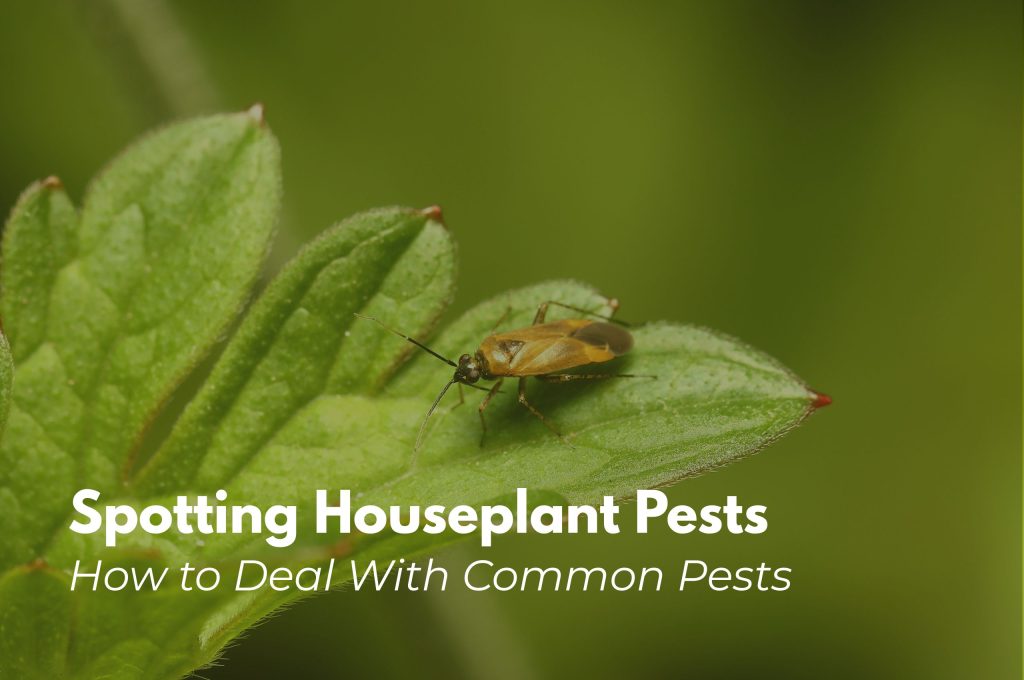
Houseplants can offer several benefits for your home, including cleaner air and a calmer atmosphere. Unfortunately, plants are also food for bugs and other pests, so be aware of the signs of pest-related damage. All of Studley’s houseplants are cultivated and grown in our Rochester, New Hampshire greenhouse, and we do everything we can to ensure all of our plants are healthy and hardy before selling them in our store or shipping them to our customers. To that end, we spend a fair amount of time thinking about houseplant care! Below are a few tips and tricks to help you spot and deal with pests on your plants.
The first symptom of pests is damage or discoloration to the leaves. The mere presence of damage or discoloration indicates that your plant may have pests, and the type of damage will provide a good indication of which pests are present. Speckling or mottling, tiny pale or yellow dots on the surface of the leaves, likely means that your plant has spider mites. Silver streaks or brownish scars on the leaves, especially new growths, are a common sign of thrips. Distorted, curling leaves are a telltale sign of aphids.
Beyond foliage damage and discoloration, there may be other visual symptoms such as residues and growths on your plants. Fine silk webbing underneath leaves or between stems and leaf joints are typical evidence of spider mites. Mealybugs can leave white, cottony masses or small fluffy white clumps clustered along stems and leaf axils. Multiple pests, including aphids, scale insects, and mealybugs, leave a sticky sap-like substance on leaves and nearby surfaces. Look for sticky or shiny leaves.
Some pests make themselves easy to spot. If you see tiny flying bugs hovering above the potting soil or congregating on nearby windows, those are most likely fungus gnats. The presence of these bugs indicates that the top layer of soil is consistently too wet. Scale insects are subtler, but you can still see them with the naked eye. If you see small, raised, hard, brown or tan immobile bumps that weren’t there before, those are probably scale insects. Look for them on plant stems and central leaf veins.
Once you identify the pests, the next step is to remove these unwelcome house guests. First, isolate the affected plant to prevent pests from spreading to other houseplants. Physically wipe away the pests or remove them by forcefully spraying them with water. You can directly target mealybugs and scale insects by dipping a cotton swab in rubbing alcohol and dab individual bugs to kill them on contact. If you have fungus gnats, place sticky traps in the soil to catch the adult bugs.
After removing the pests, spray your plants with neem oil or insecticidal soap. Be sure to spray both the tops and bottoms of the leaves and repeat about once a week to target newly-hatched eggs. For soil pests, you can drench the soil with 1 part 3% hydrogen peroxide with 4 parts water or apply a layer of diatomaceous earth to the dry topsoil.
To prevent further infestations, a few simple precautions can protect your houseplants.
Fresh Blooms, Fresh Ideas